If your residence is around Black Lake, you must have heard about Purple Bladderwort (Utricularia Purpurea) an indigenous carnivorous free-floating plant found in your lake and many places in the Eastern part of North America but rarely in Quebec. When abundant, it can be bothersome but it is otherwise harmless.

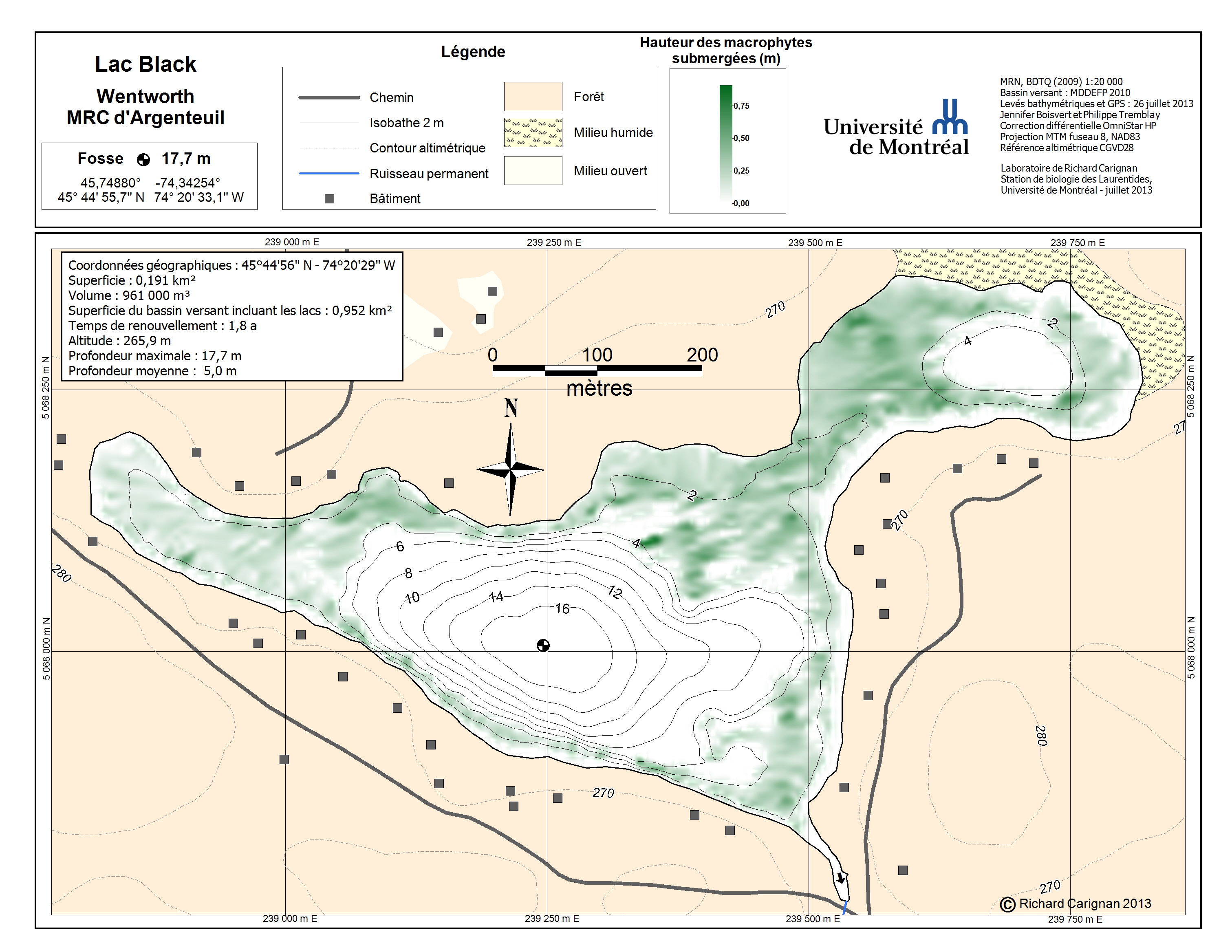
The following underwater video ( 2.5 minutes) was shot in June 2015 in the eastern section of Black Lake. The author is Dr. Richard Carignan, one of Quebec’s foremost lake experts. He has also produced the macrophytes (large aquatic plants) map (below) as well as the great bathymetric maps of our lakes you see on the home page of this web site.
He has identified, en français, the numerous plants seen in the video. These are their English names. In Bold. First, in order of appearance, is la Vallisnérie américaine, (Vallisneria Americana), then Brasénie de Schreber, (Schreber Watershield), Potamot à large feuilles, (Large-Leaved Pondweed) then lots of Purple Bladderwort. Finally, a composite of the latter, plus Vallisnérie américaine (Tapegrass) and some Potamot émergé (Ribbonleaf Pondweed). All of these plants, except the Purple Bladderwort, are common in our lakes.
We do not know how long this carnivorous plant has been living in Black lake or how it got there. And why there is none in Boyd where tons of Black Lake water flow almost all year round. Nobody knows!
Strangely, a survey of aquatic plants* on Boyd and Black lakes produced in 1980 by Vanier College and published in 1981 does not mention Purple Bladderwort on it’s list of aquatic plants.
However, we know that there were a lot of aquatic plants on Black Lake when this map was done in 2013. It became clear in the following years that it was mostly Purple Bladderwort. It was assumed then that they were less abundant when water levels were high. But, in 2018, that theory went underwater as the area that previously covered the eastern part of the lake shrank dramatically, roughly by 2/3, even with the low water levels during that beautiful hot summer!
This is the map produced in 2013. As you can observe, plants – mostly Purple Bladderwort – cover a significant part of the lake, mostly in the bay in the eastern section of the lake.
The situation changed dramatically in 2019 when the purple bladder wort cover was reduced by 40 to 50% and again by 80 % in 2020. And in 2021, only about 10% of the original coverage was left.

The following year, in 2022, an increase in the coverage of roughly about 20% of the original coverage was observed. And then, in 2024, the coverage expanded considerably. In 2025, the coverage is less significant but more inconvenient for residents as shown in this photo taken in September. This is not scientific data, but a good illustration of the very dynamic behaviour of this plant.
Status in 2026
True to form, 2026 was a bit special. Early in July, residents of the western end of the lake noticed that bunches of plants had drifted to their area. Clearly, these were blobs of Purple Bladderwort that had drifted from the eastern end of the lake. Fortunately, most of them dispersed after a couple of days.
In mid-August, I went back to the eastern part of the lake to assess the situation. Have a look at the picture I took! Yeah, there is almost no Purple Bladderwort. The aquatic plants you see up front are Pickerelweed.

Little is known about this carnivorous plant, known for its sporadic population explosions documented in some northern Wisconsin lakes within the last 20 years. Very little research has been published even though there is an organization called the International Carnivorous Plants Society. Almost nothing about Purple Bladderwort.
Conclusion
Bottom line: we are looking at a cyclical phenomenon driven by the weather. Temperature, rainfall, and seasonal changes and, possibly climate change, impact the growth cycle of Bladderworts. Warmer temperatures may enhance their growth, while extreme weather events, such as droughts or floods, can alter their habitats, either promoting or hindering expansion.

It is true that these plants are sometimes a nuisance for some residents, especially those living on the eastern sector of the lake.
However, one thing is certain: we cannot legally intervene without first obtaining a certificate from the Department of the Environment. This is a complex and expensive exercise where one must do a study demonstrating that the proposed intervention will not cause more harm than good, and that it will be effective.
I consulted the Top Gun in matters of aquatic plants – a professor at Laval University, PhD. Biology – , who told me that producing a credible study to make that demonstration is a very long shot and that, if consulted, he would not recommend the issuance of a certificate!
Let’s hope for many more years like 2026.
* A Preliminary Aquatic Survey Boyd and Black Lakes, Quebec. Technical report No. 5a 1982 H.J. Smart D.J. Oxley – Vanier College Fish and Wildlife Technology Program
Coming from a renowned professor and scientist like you, this comment is all the more appreciated.
Jacques, very informative, thanks for the research. looks like we have to live with it.
Jacques – thank you so much for looking into this as we know it is a huge concern for residents of Black lake